ysc
.png)
BLTN
AI-powered online collaboration software for law enforcement officers to enhance public safety
About Multitude Insights
Multitude Insights is a data-centered startup that aims to help law enforcement agencies resolve crimes by leveraging their unstructured data through AI and NLP. The company has won numerous awards and is an FBI-certified company.
The business goal is to contract with 100 police departments across the United States by 2023 Q4.

Problem
54% of police officers spend at least two hours of their shift writing up reports.
HMW
How might we help police officers easily share crime data?
Solution
BLTN is a SaaS-based online data sharing and analytics tool that aims to reduce the amount of criminal cases unsolved by enabling easy data sharing across law enforcement agencies

Design Process
TEAM
Lauren Choi (me), UX Designer
Chiwon Lee, Product Designer
Matthew White, Product Manager
Dan Stuart, Front-end Developer
Alex Lim, Back-end Developer
Akihito Izu, Legal
TOOLS
Figma
Figjam
Miro
Zoom
Storyboard that
MY ROLE
I contributed to UX research and crafted wireframes recognized by A’ and IF design awards.
Additionally, I enhanced the information architecture, design system, and library of reusable components.
DURATION
February, 2023 - November, 2023 (10 months)
90%
say creating incident reports limits time in the community*
89%
say they need a “connected work-place” *
Police officers dedicate an excessive amount of time to administrative tasks
*Source: 2021 Role of Technology in Law Enforcement Paperwork Annual Report
https://whatsnext.nuance.com/home-business-productivity/report-how-law-enforcement-documentation-evolved-2021/
User research analysis
To distill insights from user research, I employed open coding to identify patterns and themes. Subsequently, I created an affinity diagram using Miro to categorize these themes for translation into actionable UX design elements.
Below are sample images of the open coding and affinity diagram conducted.

User research insights
Following open coding of the transcripts, I pinpointed 4 primary themes to integrate into the product.
.png)
.png)
Persona
How can we assist law enforcement officers, such as David, in improving data coordination to enhance crime resolution?
User flow
By engaging in weekly Zoom meetings and utilizing Slack for communication with stakeholders, the product manager, and both front-end and back-end developers, I formulated user workflows supported by BLTN. The following illustrates one of the user workflows.

User scenario
Here is a user scenario demonstrating how a police officer, such as David, could utilize BLTN to enhance crime-solving capabilities.

Ideation
After completing user research and engaging in extensive communication with stakeholders, I create interface sketches to rapidly explore and visualize design concepts.
Below are samples of these paper sketches depicting various ideations.

Wireframing
I generated over 10 layout variations and refined the wireframes through 8 iterations, incorporating feedback from stakeholders and user research insights.

Search and filters
Law enforcement officers can easily search for relevant crime data through advanced search powered by Natural Language Processing.


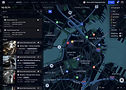
BLTN map
Law enforcement officers can easily see what kinds of incidents are happening around their neighborhood and also spot trends amongst the cases.
Integration and Ingestion
Law enforcement officers can easily ingest crime data from a document or tool to automatically upload crime data in a structured manner.

Final Design

Impact
.png)
Reflection
In law enforcement, precision and efficiency are crucial.
By directly engaging with end-users and stakeholders, I adopted an iterative design approach to create user-friendly interfaces tailored to operational needs.
This experience highlighted the significance of understanding stakeholders' specific requirements and challenges.
Direct conversations with key personnel ensured that my designs met operational needs while maintaining user-friendliness.

User Research
I conducted contextual inquiry and task analysis through user interviews with 9 police officers, crime analysts, and detectives in Massachusetts via Zoom.
Goal
-
Understand the challenges users face with their current crime data-sharing software.
-
Obtain insights into both pain points and user flow.
Sample questions:
-
What information do you care the most about incidents?
-
When writing an incident report, what are the items you need to fill out?
-
Please walk me through the current journey you go through to find relevant information for an incident.